


Contact
Write to Us And We Would Be Happy to Advise You.
Do you have any questions, or would you like to speak directly with a representative?
By 管理
You want your electronics to stay safe. You need to pick the right conformal coating. The best coating depends on your circuit board’s heat, where it is, and how you put on the coating. Experts say you should always choose a coating that fits your needs.
There are five main Conformal Coating Types. These are acrylic, silicone, epoxy, polyurethane, and parylene. Each type works best in different places. For example, manufacturers often use acrylic, urethane, and parylene because they protect well.
| Coating Type | Projected CAGR | Country/Region | Growth Rate |
|---|---|---|---|
| Acrylic | 5.4% | US | 6.9% |
| Silicone | 6.7% | China | 6.0% |
| Germany | 6.4% |
You want your electronics to work for a long time. Conformal coating helps protect circuit boards from harm. This coating acts like a shield. It blocks water, dust, and chemicals. It also keeps heat and wet air from hurting your devices. Using this coating makes electronics stronger and more dependable. The coating is a thin layer that covers the whole board. This layer keeps electronics safe in hard places. You lower the chance of problems and help devices last longer.
Tip: The right coating can help you spend less on fixing or replacing things.
Many industries use conformal coating. Each one uses it to fix different issues. The table below shows where coatings are used and why they are important:
| Industry | Application Scenarios |
|---|---|
| Electronics | Protecting PCBs, sensors, and electronic assemblies in consumer electronics, industrial equipment, aerospace, and automotive electronics |
| Harsh Environments | Protecting electronics in outdoor installations, marine environments, and extreme temperatures |
| Medical | Protecting medical devices and implantable electronics from bodily fluids and sterilization processes |
| Aerospace | Protecting components in aerospace, military, and defense applications from vibrations and shock |
You might use a coating for a phone, car, or medical device. The coating helps electronics survive water, heat, or strong shaking. You can trust conformal coating to keep technology safe in many jobs.
You should learn about the main conformal coating types before picking one. Each type has special things that make it good for certain jobs. Here are the five most common types and where you might use them.
Acrylic conformal coating is a clear layer that protects. You can put it on and take it off easily. It dries fast and does not cost much money. People use it for printed circuit boards in electronics, defense, aerospace, and cars. It keeps out water and chemicals. Many people like acrylic because it stops fungus and you can see it under UV light.
| Key Properties | Ideal Use Cases |
|---|---|
| Easy to apply and remove | Printed circuit boards |
| Low cost | Electronics and automotive |
| Moisture protection | Aerospace and defense |
| Fungal resistant | Less complex coating processes |
Silicone conformal coating is very flexible and can handle heat. You can use silicone where there is a lot of heat or water. It works from very cold to very hot temperatures. This coating soaks up shaking, so it is good for boats, cars, and planes. It keeps out water and stops rust, but it is hard to take off.
Epoxy conformal coating is strong and protects against electricity. You can use it if you need to block chemicals and water. Epoxy is good for things that use high voltage. It is tough, but it can crack if your board moves or gets hot. It is also hard to fix or take off.
| Advantages | Limitations |
|---|---|
| Strong chemical resistance | Rigid, may crack with vibration or heat |
| High dielectric strength | Hard to rework or remove |
| Good moisture protection | Complex application process |
Urethane conformal coating, also called polyurethane, protects electronics in tough places. You can use it for oil and gas, cars, and farms. It blocks chemicals, water, and fungus. This type is also good for electronics that need extra insulation.
| Application Area | Reason for Preference |
|---|---|
| Oil and Gas | Chemical and moisture protection |
| Automotive | Durability and chemical resistance |
| Agriculture | Shields from moisture and fungus |
| General Electronics | Flexibility and insulation |
Parylene coatings make a thin, even layer over your device. It blocks chemicals and water very well. Parylene is safe for the body, so you can use it for medical things like pacemakers. It also works for planes, cars, phones, and smart devices. This coating stays strong in very hot or cold places and does not break down in sunlight.
Tip: Pick parylene if you need your electronics to last a long time and stay safe.
Now you know how each of the five conformal coating types helps in different ways. Think about what you need and choose the type that fits your device and where you will use it.
You should look at different coating types before picking one. The table below shows how each type works in key areas. These areas are repairability, moisture resistance, chemical resistance, and cost. This makes it easier to see which coating is best for your project.
| Coating Type | Reworkability | Moisture Resistance | Chemical Resistance | Thermal Resistance | Dielectric Strength | Cost | Best For |
|---|---|---|---|---|---|---|---|
| Acrylic | ★★★★☆ | ★★☆☆☆ | ★★☆☆☆ | ★★☆☆☆ | ★★★★☆ | $ | Automotive, avionics, fast repair |
| Polyurethane | ★★☆☆☆ | ★★★★☆ | ★★★★★ | ★★★☆☆ | ★★★★☆ | $$ | Industrial, harsh zones |
| Silicone | ★★☆☆☆ | ★★★★★ | ★★★☆☆ | ★★★★★ | ★★★★★ | $$$ | High-temp, outdoor, solar |
| Parylene | ★☆☆☆☆ | ★★★★★ | ★★★★☆ | ★★★★★ | ★★★★★ | $$$$ | Medical, aerospace, telecom |
| Epoxy | ★☆☆☆☆ | ★★★★☆ | ★★★★☆ | ★★★☆☆ | ★★★★☆ | $$ | High-voltage, chemical exposure |
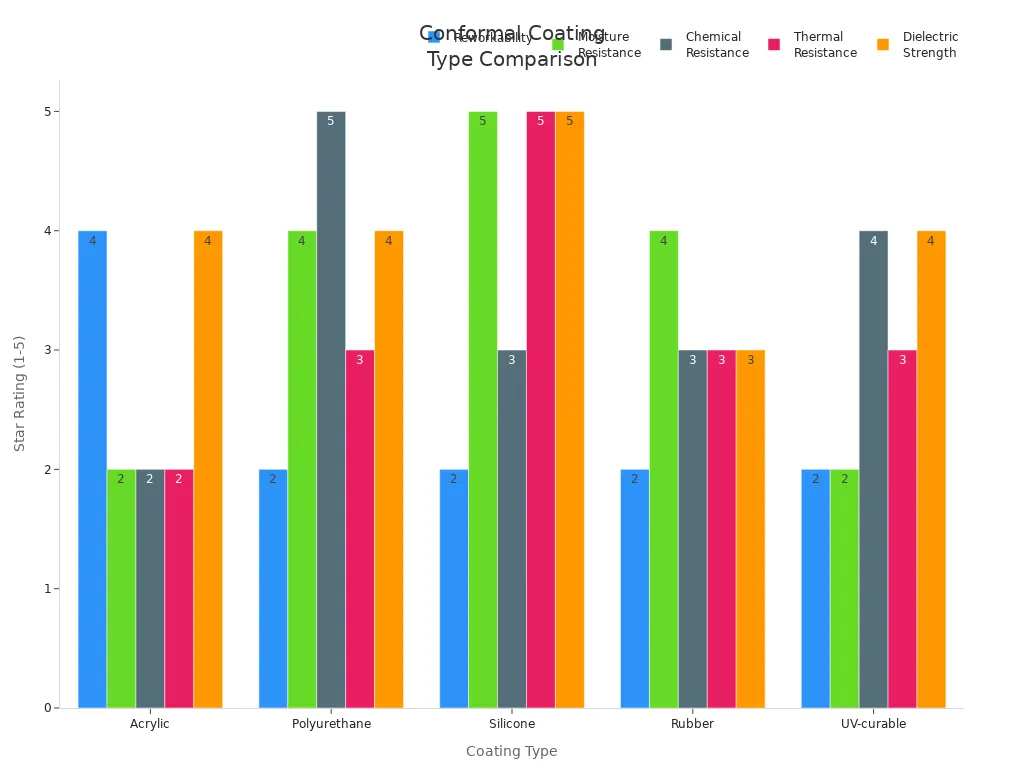
It is important to know what each coating does well and what it does not. This helps you stop problems before they start.
| Coating Type | Pros | Cons |
|---|---|---|
| Acrylic | Easy to apply, good coverage | Moderate protection, limited temperature resistance |
| Polyurethane | Tough, strong chemical resistance | Hard to remove, less reworkable |
| Silicone | Handles heat and moisture, flexible | Higher cost, harder to rework |
| Parylene | Thin, even layer, near-hermetic seal | Expensive, slow process, not for high-volume |
| Epoxy | Strong, good for chemicals | Rigid, cracks with movement, hard to repair |
You need to match the coating to your device and where it will be used. Here are the best uses for each type:
Tip: Always check what your device needs before you choose a coating. The right choice keeps your electronics safe and working longer.
You need to think about where your pcb will be used. Some places are very wet or have salty air. Other places have harmful gasses or even water all around. These things can hurt circuit boards fast. You should pick a coating that matches the real dangers your electronics will face. Silicone and polyurethane coatings work well in wet or salty places. Acrylics are better for indoor or less tough spots.
Tip: Always check the environment before you pick a conformal coating for your pcb.
You should check how much electricity your pcb uses. Dielectric strength is important if your board uses high voltage. Thermal resistance helps your pcb handle hot or cold places. Many conformal coatings can help with these needs. If your pcb gets hot and cold, the coating can stop cracks and protect solder joints. You also want a coating that is easy to use and strong enough for your job.
There are many ways to put conformal coating on your pcb. Manual spray is good for small jobs. Automated spray guns are better for lots of boards. Selective coating only covers certain parts of the pcb. Dipping covers both sides of the board. Brushing is best for fixing small spots. Each way changes how well the coating works and how fast you finish.
| Application Method | Description | Suitability for Production Volume | Performance Impact |
|---|---|---|---|
| Manual spraying | Use a spray can or handheld spray gun. | Low volume | Takes time, quality depends on the person spraying. |
| Automated spraying | Machines move pcbs under a spray head. | High volume | Coating is even, less work for people. |
| Selective coating | Robot nozzle puts coating on certain areas. | High volume | No need for masking, very exact. |
| Dipping | Put the pcb in coating to cover both sides. | High volume | How well it works depends on speed and thickness of the liquid. |
| Brushing | Use a brush by hand, mostly for repairs. | Small production runs | Takes a lot of work, results can change a lot. |
You should follow rules when you pick a conformal coating. These rules help make sure your pcb is safe and good quality. IPC A 610 is a common rule for consumer and important boards. IPC-CC-830B checks if your coating meets electrical and performance needs for all coatings.
| IPC Standard | Description |
|---|---|
| IPC A 610 | Common rule for consumer and important printed wiring assemblies, gives steps for conformal coating. |
| IPC-CC-830B | Checks if the coating is good for electrical insulation on printed wiring assemblies, works for all coatings. |
Note: Always check your coating needs with these rules before you choose.
You must follow steps to pick a conformal coating for your printed circuit board. Experts say you should first check what your board will face in its environment. Use these steps to help you choose the right coating:
Tip: Always test your coating before using it on all your boards. This step helps you avoid mistakes and keeps your electronics safe.
You should also check important factors in a table. This makes it easier to compare what matters most for your project.
| Factor | Description |
|---|---|
| Environmental Conditions | Look for humidity, big temperature changes, or chemicals. |
| Dielectric Properties | Make sure the coating stops electrical shorts. |
| Thermal Resistance | The coating must handle temperature changes. |
| Application Method | Some coatings need special tools or machines. |
| Repairability | Decide if you need to remove or fix the coating later. |
| Cost and Availability | Make sure the coating fits your budget and is easy to get. |
You can use a decision matrix to help you pick the best coating for your board. This matrix lets you compare common conformal coatings based on your needs. You can see which coating fits your project best.
| Need/Property | Acrylic | Polyurethane | Silicone | Epoxy | Parylene |
|---|---|---|---|---|---|
| Moisture Resistance | Good | Excellent | Excellent | Very Good | Excellent |
| Chemical Resistance | Moderate | Excellent | Good | Excellent | Very Good |
| Thermal Resistance | Moderate | Good | Excellent | Good | Excellent |
| Dielectric Strength | Good | Good | Excellent | Excellent | Excellent |
| Ease of Application | Easy | Moderate | Moderate | Difficult | Difficult |
| Repairability | Easy | Moderate | Moderate | Difficult | Difficult |
| Cost | Low | Moderate | Moderate | Moderate | High |
| Best Use | Indoor, basic protection | Harsh environments | Outdoor, high temp | High voltage, chemicals | Medical, aerospace |
Note: Always check the conformal coating guidelines for your industry. These guidelines help you meet safety and quality standards.
You can also look at new trends and technologies. Nanotechnology coatings and bio-based coatings offer better strength and faster curing. UV-curable coatings help you finish jobs quickly and use less energy. Many industries now use water-based coatings to meet environmental rules.
Callout: If you work with high-reliability electronics, you need to check moisture vapor permeability and coating coverage. Low permeability means better moisture protection. Complete coverage stops failures.
You should always follow conformal coating guidelines to keep your board safe and working well. The right coating protects your board from moisture, chemicals, and heat. You can trust this guide to help you pick the best coating for your project.
You want your electronics to stay safe. Start by using the right steps for putting on conformal coatings. Always work in a place that is clean and dry. Dust or water can make the coating not work well. Pick the best way to put on your coating. You can spray, dip, or brush it on. Each way has its own steps. Make sure you cover every part that needs to be safe. Use masking to keep coating off places that should not have it. After you finish, let the coating dry all the way. Some coatings dry in air. Others need heat or UV light to cure. Do not hurry this step. Letting it cure right keeps your electronics strong and safe for a long time.
Tip: Keep the room’s temperature and humidity the same while you work. This helps stop bubbles and weak spots from forming.
You need to check your work to make sure your electronics are safe. Use special tools to see if the coating covers everything. Optical systems help you look at the coating. Ultrasonic gauges tell you how thick the coating is. Some tools show problems while you work. These machines help you fix mistakes fast.
Keep your workspace clean and control the temperature. Always mask off places that should not get coated. Check your spray or dip settings to make sure the coating is even. These steps help you follow strict rules for good electronics.
Sometimes you need to take off or fix a coating. There are safe ways to do this. Solvents can remove most coatings, like acrylics. Use the right solvent so you do not hurt your electronics. You can peel off some silicone or flexible coatings. For hard coatings, use a soldering iron to burn through. Microblasting uses soft grit and air to take off coatings like parylene and epoxy. Grinding or scraping can also work for tough coatings, but only use this if nothing else works. Always follow safety rules to keep your electronics safe when removing coatings.
Note: Pick the removal way that matches your coating type. This keeps your electronics safe and ready for new protection.
You can pick the right conformal coating by using these steps. First, find out what dangers are in your environment. Next, check what rules your coating must follow. Then, see if you need a certain thickness. Last, think about cost, reliability, and how simple it is to use.
Choosing a coating that fits your needs helps keep electronics safe and working well.
| Factor | Impact on Coating Selection |
|---|---|
| Operating environment | Needs moisture and corrosion resistance |
| Temperature range | Needs flexible materials |
| Chemical exposure | Needs solvent-resistant coatings |
If your project is complicated, costs may be high and you must control the process carefully. Experts can help with hard problems like picking materials and checking your work.
Conformal coating keeps your circuit boards safe from water, dust, and chemicals. This thin layer helps your electronics last longer. It also helps them work better in hard places.
Yes, you can take off most coatings. Acrylics come off with special liquids. Silicones and polyurethanes might peel or need special tools. Always use the right way to remove your coating.
You need to think about where your device will be used. You should also check what your device needs and how much money you have. Use a chart to compare different types. Try the coating on a small spot first to see if it works.
Conformal coating makes electrical insulation better. It stops short circuits and keeps voltage spikes away. You should always check the dielectric strength before you use the coating.
Exploring Various Conformal Coatings: Pros And Cons
Essential Aspects Of Conformal Coating In PCBA Manufacturing
Advantages Of Using Conformal Coating In PCBA Applications
Challenges Faced In SMT Assembly For Conformal Coating
Navigating The Design Process For Industrial Controller PCBs
Do you have any questions, or would you like to speak directly with a representative?