


Contact
Write to Us And We Would Be Happy to Advise You.
Do you have any questions, or would you like to speak directly with a representative?
By 管理
Have you ever thought about why some electronics are made in small groups, while others are produced in huge numbers? The significant difference between Low-Volume vs High-Volume PCBA Production lies in the quantity of circuit boards you need and the ease of making changes. Choosing the right production method can help you save money, complete your project faster, and experiment with new ideas quickly.
| Aspect | Low-Volume PCBA Production | High-Volume PCBA Production |
|---|---|---|
| Cost | Each unit costs more | Each unit costs less |
| Flexibility | Changing designs is easier | Hard to change once production starts |
| Efficiency | Produces fewer boards, not as fast | Produces many boards, very quickly |
| Ideal Use | Great for testing and special needs | Ideal for mass production |
You may wonder what low-volume pcb manufacturing is. It means making only a small number of PCBs at one time. People use this method when they want to test a new idea or make something special. Companies use low-volume pcb manufacturing for prototypes or unique projects. You can see how different groups explain low-volume PCB assembly in the table below:
| Source | Definition of Low-Volume PCB Assembly |
|---|---|
| East End Assemblies | Typically involves tens to a few thousand boards per run. |
| IT Supply Chain | Manufacturing and assembling in quantities ranging from 25 to 5,000 units. |
| Technotronix | Manufacturing a small batch of boards, typically from a few units to several hundred. |
| Fastlink Electronics | Producing a relatively small quantity, usually from several units to a few hundred or thousand. |
You can pick low-volume pcb manufacturing if you need just a few boards or up to a few thousand. This way, you get more choices. You can change your design after each batch. You do not have to spend a lot of money at once. You can get your boards faster because smaller batches take less time. You also get careful testing and checking. Here is a table that shows how flexible low-volume and high-volume PCB assembly are:
| Aspect | Low-Volume PCB Assembly | High-Volume PCB Assembly |
|---|---|---|
| Flexibility | Allows design changes between builds | Assumes design is locked |
| Financial Risk | Controlled total financial exposure | High risk if design issues arise |
| Design Iteration | Supports expected design changes | Small changes require requalification |
| Turnaround Speed | Quick for smaller batches | Longer setup time for large runs |
| Quality Control | Combines automated and hands-on inspection | Relies on automated inspection |
Low-volume pcb manufacturing gives you many good things. You can make and test new boards quickly. You can change your boards to fit special needs. You do not waste money on extra boards you do not need. You can fix your design after each batch, so you do not take big risks. You also get your boards faster, so you can sell your product sooner.
Low volume assembly lets you make special boards and use special ways to build them. These ways may not work or cost too much for high-volume production. This helps when your project has special needs or very detailed designs.
You can use low-volume pcb manufacturing to try out ideas, make changes, and build products that are just right for you.
High-volume PCB assembly is used when you need thousands of boards. This is good for products that many people buy, like phones or computers. Big factories use this method to make lots of electronics for stores. The smallest amount for high-volume PCB assembly depends on what you are making. Look at this table:
| Project Type | High Volume |
|---|---|
| Simple PCBA | 5,000+ pcs |
| Complex PCBA | 1,000+ pcs |
You pick high-volume PCB assembly if you want many boards fast and want each one to cost less.
Factories use the same steps for every board. This makes sure all boards work the same way. Machines put parts on the boards and solder them very quickly. These machines help keep the boards good and the price low. Factories use strict checks and automatic steps to keep quality high. Here are some ways these steps help:
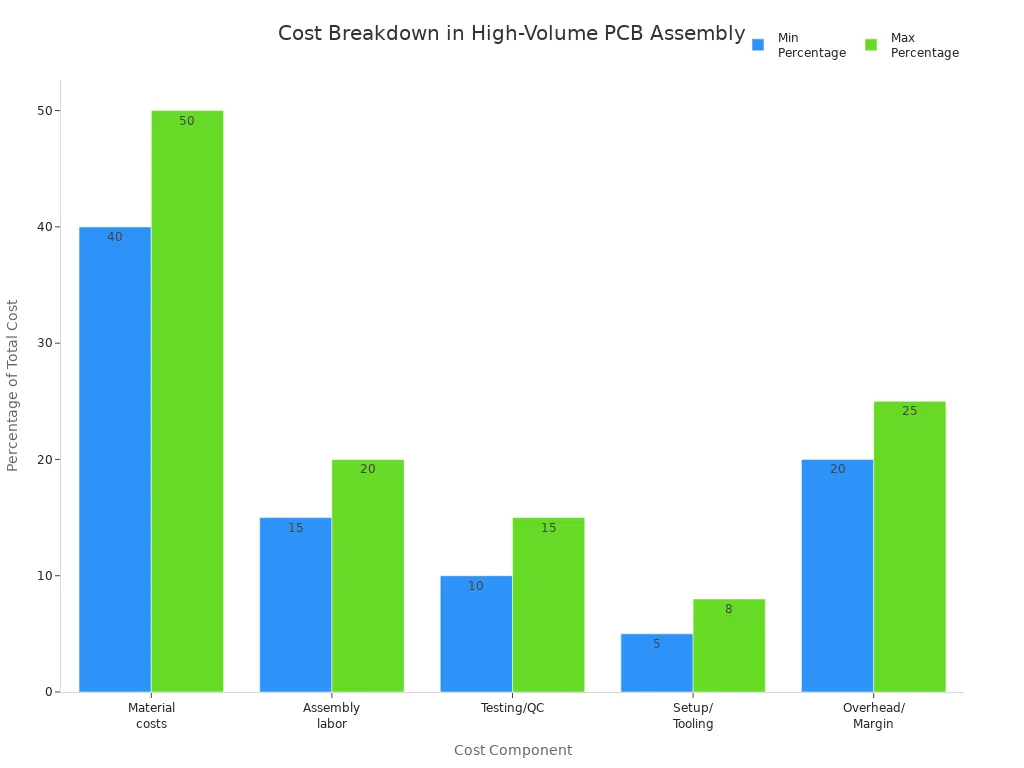
You save money because factories buy lots of parts at once. They also spread setup costs over many boards. Here is a table that shows how the costs are split in high-volume PCB assembly:
| Cost Component | Percentage | Description |
|---|---|---|
| Material costs | 40-50% | Decreases with volume through bulk purchasing |
| Assembly labor | 15-20% | Dramatically reduced through automation |
| Testing/QC | 10-15% | Amortized across larger batches |
| Setup/Tooling | 5-8% | Fixed costs spread across more units |
| Overhead/Margin | 20-25% | General overhead and profit margin |
Using machines in PCB manufacturing is important for making lots of boards. Automation helps keep quality high and makes work faster. Machines can do paneling and etching with less human work and more speed.
You pay less for each board because setup costs are shared. When you order more boards, the cost for each part goes down.
High-volume PCB assembly usually means making thousands or tens of thousands of boards. This way of making boards has some problems you should know:
You must make sure every board is good. Small mistakes in soldering or putting on parts can cause problems. Saving money by using cheaper parts can make boards worse. Using too many fancy parts can make boards cost too much.
You need to plan well and check quality often to stop problems in high-volume production.
When you look at low-volume and high-volume pcba production, you notice big changes in cost, speed, flexibility, and quality. Each way works best for different needs in pcb assembly. Let’s go over the main points so you can pick the right method for your printed circuit board assembly project.
Low-volume pcb assembly costs more for each board. Setup costs are split between fewer boards. You cannot buy materials in large amounts. This makes each board cost more. High-volume pcb assembly lets factories buy lots of parts at cheaper prices. Setup costs are spread over thousands of boards. This makes each board much cheaper.
| Factor | Low Volume Assembly | High Volume Assembly |
|---|---|---|
| Cost per Unit | Higher | Lower due to economies of scale |
Think about how many boards you need. If you want to save money on each board, high-volume pcb assembly is best.
Low-volume pcb assembly has shorter setup and lead times. You can get your boards in just a few days. High-volume pcb assembly takes longer to set up. Factories need more time to get machines and tools ready. This means you wait longer for your boards.
| Production Type | Setup Time | Lead Time |
|---|---|---|
| Low Volume | Shorter | Quicker completion times, often within days |
| High Volume | Longer | Delayed early production due to setup |
If you need your boards quickly, low-volume production is a better choice.
Low-volume and high-volume pcba production are very different when it comes to customization. Low-volume pcb assembly lets you change your design often. You can make special boards for unique needs. This is good for things like medical devices or robots. High-volume pcb assembly makes many boards the same way. You cannot change the design easily after production starts.
Pick low-volume if you want to try new ideas or need special features.
Quality is important in every pcb assembly. Low-volume and high-volume pcba production use different ways to check quality. Low-volume pcb assembly uses more hands-on checks and flexible tests. High-volume pcb assembly uses machines and detailed programs to make sure every board is the same.
| Quality Control Measure | Low Volume | High Volume |
|---|---|---|
| Automated Optical Inspection | Simpler programming, finds big errors | Detailed programming, finds small changes |
| Electrical Testing | Flying Probe Test, flexible but slow | Bed of Nails Test, fast but needs custom fixture |
| First Article Inspection | Simple process, checks setup | Formal, detailed checks, more paperwork |
Both types have careful testing, but high-volume pcb assembly focuses more on making every board match.
The tools and machines used in pcb assembly depend on how many boards you make. Low-volume pcb assembly uses flexible machines and cheap tools. These tools are good for small runs and let you change designs fast. High-volume pcb assembly uses strong, expensive tools that last a long time. These tools help make many boards quickly and keep costs low.
| Production Volume | Tooling Type | Description |
|---|---|---|
| Low Volume | Flexible/Adjustable | Cheap tools, good for small runs, easy to change |
| High Volume | Hard Tooling | Expensive steel fixtures, last for many cycles |
| Low Volume | General-Purpose Machines | Easy to set up, more manual work |
| High Volume | Dedicated Automated Systems | Robots move panels, fast but slow to change setup |
| Low Volume | Frameless Stencils | Thin, cheap stencils for prototypes |
| High Volume | Framed Stencils | Strong, coated stencils for high precision and long use |
| Low Volume | Flying Probe Test | Robotic probes check one by one |
| High Volume | Bed of Nails Test | Custom fixture tests all points at once |
Match your equipment to your production needs. If you want to change designs often, use low-volume pcb assembly. If you want to make many boards fast, use high-volume pcb assembly.
Tip: When you compare low-volume and high-volume pcba production, you should think about supply chain needs. Low-volume pcb assembly needs flexible sourcing and careful inventory. High-volume pcb assembly uses bulk orders and steady suppliers to keep costs low and avoid delays.
Here is a simple table to help you see the main differences:
| Aspect | Low-Volume PCB Assembly | High-Volume PCB Assembly |
|---|---|---|
| Cost per Unit | Higher | Lower |
| Setup/Lead Time | Shorter, faster | Longer, slower |
| Customization | Very flexible | Limited |
| Quality Control | Hands-on, flexible | Automated, consistent |
| Equipment | Easy to change, low-cost | Hard to change, high-cost |
| Supply Chain | Needs flexibility | Uses bulk orders |
When you compare low-volume and high-volume pcba production, you see that each method has its own strengths. Choose based on your project’s size, speed, and need for changes.
You need to test your ideas before making lots of boards. Low volume pcb assembly lets you build prototypes fast. You can check your designs and see how they work. This helps you fix problems early. You can go from an idea to a real board in just a few days. Rapid prototyping helps you find mistakes and change things quickly.
Low volume pcb assembly lets you improve your design step by step. You can make changes fast. This helps you get your product to market sooner and stay ahead.
If you have a startup or a new product, low volume pcb assembly is very helpful. You can make small batches and change your design as you learn. This method helps you move from early prototypes to bigger production. You do not spend a lot of money until you know your product works.
Low volume pcb assembly helps you plan your launch and decide when to make more boards.
Some products need special features or are made for unique markets. Low volume pcb assembly is great for these needs. You can make custom boards in small amounts without spending too much. This works well for:
You can meet strict rules and make high-quality prototypes for tough industries.
Making products often means you need to change your design fast. Low volume pcb assembly lets you update your design and build new boards quickly. You can keep your project moving and use new ideas.
Flexible schedules and quick builds help you control your project. You can make changes when you need and keep your team working well.
High-volume PCB assembly is used for products many people buy. Companies use this method to make lots of devices fast and for less money. Some examples of these products are:
With high-volume assembly, you can make enough products for big markets. This keeps prices low and helps more people get your products. It also helps you give good, reliable items to many customers.
If your product sells well and does not change, high-volume PCB assembly is a good choice. You can make thousands of circuits at the same time. This makes design and building faster. Machines do most of the work, so it takes less time and fewer workers. Every circuit is tested the same way, so quality stays high. Making many boards at once lowers the cost and helps you compete.
High-volume PCB assembly helps you keep up with orders and make sure your products are always good.
If you want to save money, high-volume PCB assembly is a smart pick. Panelization lets you use materials better and makes building faster. You can save 20-30% or even more when you make a lot of boards. Small batches cost much more for each board. For example, making 10 PCBs can cost 5-10 times more for each one than making 1,000 PCBs. High-volume production spreads setup costs over many boards, so each board is cheaper.
You can spend less and sell your products for a better price if you use high-volume PCB assembly for projects where cost matters.
High-volume PCB assembly is great if you want to make the same thing for a long time. Setup costs are shared by many boards, so each one costs less. Machines make the work faster and keep quality the same. After setup, you can make boards quickly. Special machines check every board to make sure they are good.
High-volume PCB assembly helps you make good products for many years and keeps your customers happy.
Before you pick low-volume or high-volume PCBA production, you should think about some important things. First, look at what you want your project to do. If you need to test new designs or change things often, low-volume production is a good choice. You can try new ideas and change your board after each batch. This does not cost too much money.
If you want to make thousands of boards that will stay the same, high-volume production is better. You save money on each board because factories buy lots of parts at once. Machines help make every board the same, so the quality stays steady.
Here are some main points to help you choose:
Tip: Think about how many boards you need and if you want to change your design often. This will help you pick the best way to make your boards.
You can use this table to see the main differences between low-volume and high-volume production. It helps you match your project to the right PCBA volume.
| Factor | Low Volume Production | High Volume Production |
|---|---|---|
| Flexibility | Easy to change and test designs | Standard process, less flexible |
| Cost per Unit | Higher | Lower |
| Setup Costs | Higher per board | Lower per board |
| Design Iteration | Great for testing and changes | Hard to change after setup |
| Lead Times | Fast for small runs | Longer setup, fast after start |
| Quality Control | More hands-on checks | Consistent, automated checks |
| Best For | Startups, prototypes, custom needs | Mass production, steady demand |
You can notice big differences between low-volume and high-volume PCBA production. Low-volume lets you change things quickly and make small batches for testing or special needs. High-volume is for making lots of boards at once. It uses machines to keep costs low and quality the same. You should think about your project goals, how much money you have, and how often you want to change your design.
Think about what is most important for your project. You can share your story or ask questions below. Your ideas help others pick the best way to build their boards.
You choose low-volume for small batches and easy changes. High-volume works best for making thousands of boards at a lower cost per unit.
Low-volume gives you flexibility. High-volume gives you cost savings.
Yes, you can start with low-volume to test your design. When you feel ready, you can move to high-volume for mass production.
Low-volume PCBA usually takes less time to set up and complete. You get your boards faster because you make fewer at once.
High-volume PCBA costs less per board. You pay more upfront for setup, but each board costs less when you make many.
High-volume saves money if you need a large quantity.
Ensuring Quality Production Through Advanced Turnkey PCBA Factories
Essential Materials Required for Effective PCBA Production
Comprehensive Overview of PCBA Manufacturing Processes for All Levels
Optimal Strategies for Enhancing SMT Lines in PCBA Production
Enhancing Business Efficiency Through PCBA Contract Manufacturing
Do you have any questions, or would you like to speak directly with a representative?